Should I build an MVP?
I don't think most founders need an MVP. I think they need proof that someone cares. Here's how I'd decide when it's finally time to build.
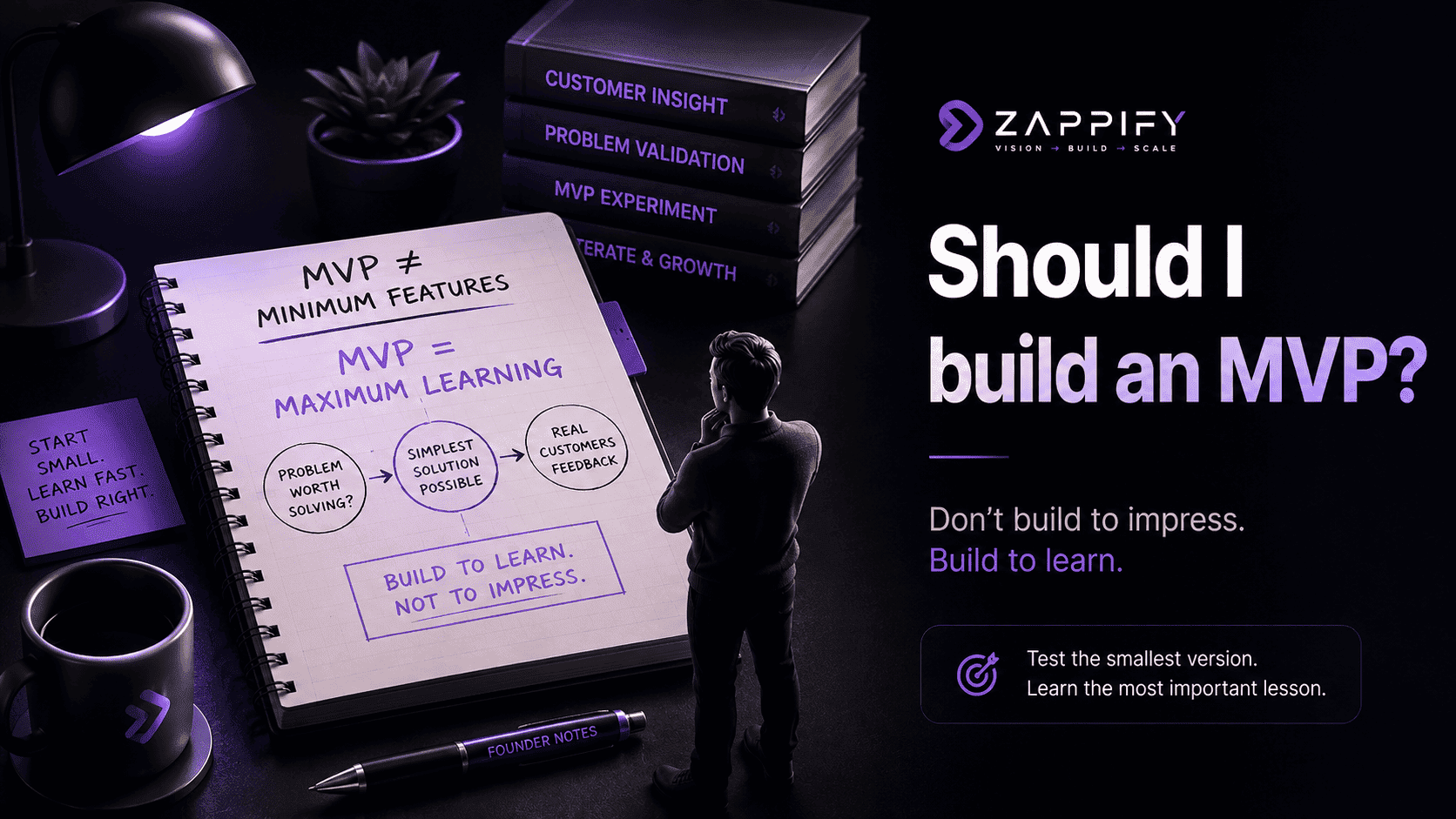
Short Answer Yes. But only after you've spoken to enough people to know the problem is real. An MVP isn't there to prove you can build software. It's there to find out if people actually want it. If you don't know who your first customer is yet, I'd wait.
Why I think this? One thing I've noticed is that founders get excited the moment they have an idea. The first question they ask is, "How much will it cost to build?" I think they're asking the wrong question. The better question is, "If I build this, who's going to use it?" One founder came to us wanting to build a marketplace. He already had wireframes. He'd spent weeks planning features. When we asked who his first ten customers would be, he couldn't answer. We told him to pause. Instead of building, we asked him to spend a few weeks talking to people. Those conversations completely changed the product. Half the features disappeared. The product became much simpler. More importantly, it became something people actually wanted. I've seen the opposite too. One teacher came to us because she was tired of spending every evening updating student records. She didn't need convincing that the problem existed. She lived it every day. She already knew teachers would use something better. That became Tracklet . The first version wasn't fancy. It only solved one problem. That's exactly why people started using it. I've noticed something after working with dozens of founders. The startups that succeed don't usually build the best first product. They build the smallest product that solves one painful problem really well. Everything else comes later. That's why I think people misunderstand what an MVP is . It's not version one of your dream product. It's the smallest thing you can build that makes one person say, "This is exactly what I needed." Once that happens, you've earned the right to build more. If I were starting from scratch... I'd forget about building a big product. I'd write down the one problem I wanted to solve. Then I'd ask myself one question. "What's the smallest thing I could build that solves just this?" If the answer was a landing page, I'd build a landing page. If it was a simple form connected to a spreadsheet, I'd build that. If it needed software, I'd build only one workflow. Not ten. I'd launch it as quickly as possible, and watch people use it. Only then would I decide what to build next.
FAQs
How much does it cost to build an MVP?
There isn't one useful MVP price because the scope can be completely different from one product to another. A simple first version can be relatively cheap, while multiple user types, payments, integrations, mobile apps, and complex workflows can push the cost up quickly. The best way to reduce cost is usually to reduce what you build, not simply find cheaper developers.
How long does it take to build an MVP?
A focused MVP can often be built in a week or a couple of weeks, while a more complex one can take several months. I'd be more concerned about the scope than the calendar. If your MVP needs dozens of screens and hundreds of features, the problem isn't that your developer is slow. Your first version is probably too big. Current industry guides commonly put MVP timelines around several weeks to a few months, depending on complexity.
Can I build an MVP myself without knowing how to code?
Yes, especially if the first version is simple. No code tools and AI coding tools have made it much easier for non technical founders to build working products themselves. But I'd be careful about spending three months learning technology when your real job is learning about customers. If building becomes the thing slowing down customer conversations, I'd get help.
Can AI build my MVP for me?
Yes, AI can now build a surprising amount of an MVP, especially for straightforward software products. But I wouldn't confuse being able to generate software with knowing what software to build. AI makes the building part faster. It doesn't tell you whether customers care, whether your workflow makes sense, or what you should build next. That judgment still sits with you.