Should I start a startup?
Thinking about starting a startup? Before you spend months building an idea, here's the framework I'd use to decide whether it's worth taking the leap.
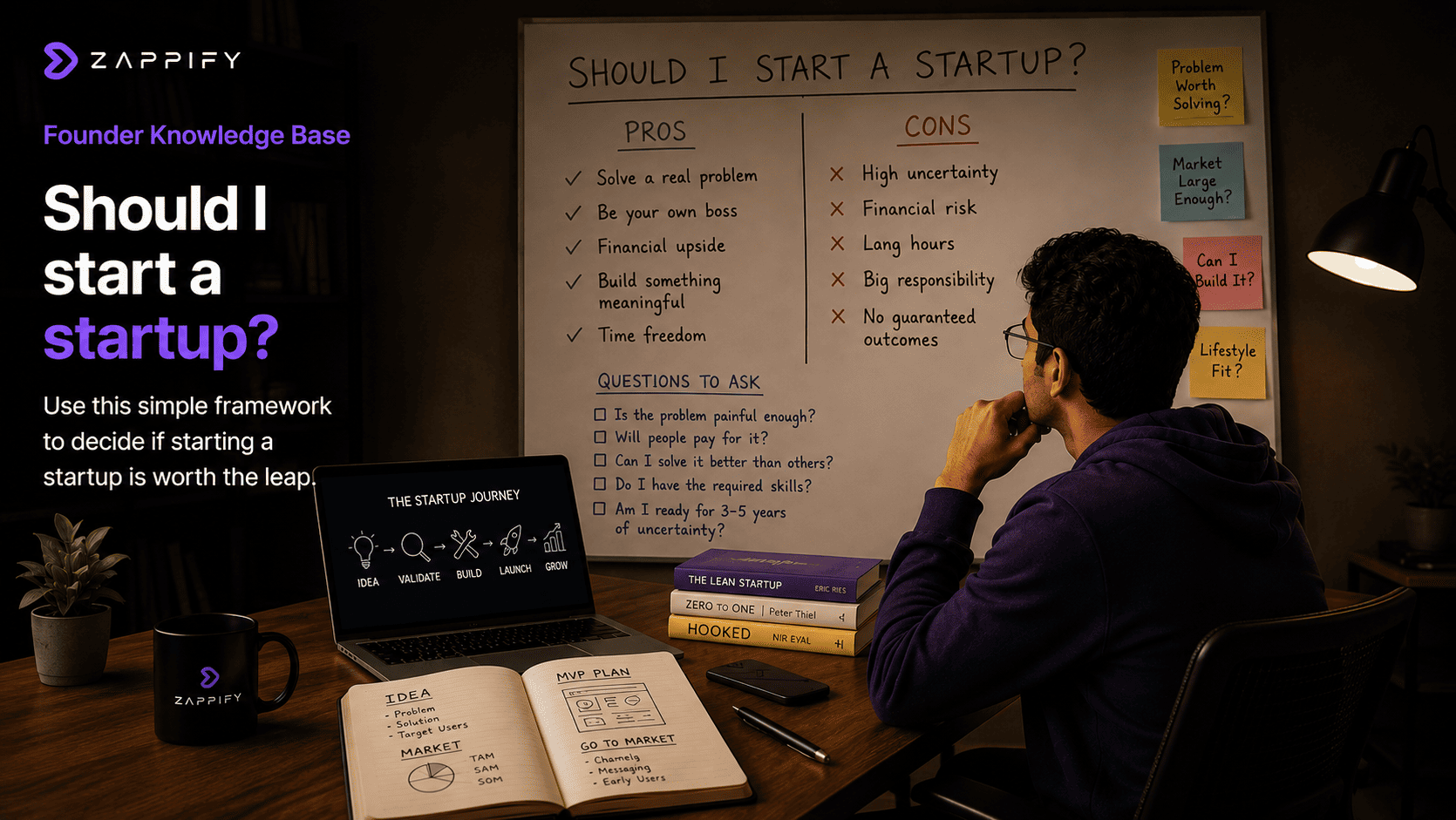
Short Answer Yes. But not because you want to be an entrepreneur. Start one because you've found a problem that genuinely frustrates you, and you can't stop thinking about how to solve it. If you're chasing money, freedom, or the title of being a founder, you're probably starting for the wrong reasons.
Why I think this? I think social media has completely distorted what entrepreneurship looks like. It makes it feel like founders spend their time raising money, hiring people, and celebrating milestones. In reality, most of your time is spent talking to customers, getting rejected, changing your mind, and realizing your first idea wasn't that good. That's why I don't think everyone should start a startup. If your goal is simply to work for yourself or make more money, there are easier ways to get there. The founders I've enjoyed working with all had one thing in common. They weren't obsessed with building a company. They were obsessed with solving a problem. The company was simply the vehicle. Take Calendly . Before starting Calendly, Tope Awotona worked in enterprise software sales. Every day he found himself sending endless emails just to schedule one meeting. "Are you free Tuesday?", "No, what about Wednesday?", "Actually, that slot is gone too." A simple 30 minute meeting often took days to organize because of all the back and forth. Instead of accepting that as normal, he asked, "Why can't people just see my availability and book a time?" That frustration became Calendly. He wasn't trying to build the next unicorn. He was trying to eliminate a problem he faced almost every day. Or take PostHog . James Hawkins and Tim Glaser didn't set out to build a product analytics company. They were building other products and kept running into the same issue. Existing analytics tools felt like they were built for marketers, not developers. Rather than work around the problem, they built the tool they wished existed. That internal frustration eventually became PostHog, now one of the fastest growing developer platforms. I don't think that's a coincidence. The best startups usually don't begin with someone saying, "I want to build a startup." They begin with someone saying, "This problem is so annoying. There has to be a better way." If This Were My Startup If I were starting again today, I wouldn't spend the next three months looking for the perfect idea. I also wouldn't quit my job. I'd spend the next thirty days paying attention. Every time I caught myself saying, "Why is this still done this way?" or "This is unnecessarily frustrating." I'd write it down. Then I'd start talking to people who experience those problems every day. If, after dozens of conversations, I was still excited about solving one particular problem, only then would I think about building a startup around it. The goal isn't to find a billion dollar idea. The goal is to find a problem you'll still care about solving two years from now.
FAQs
Should I start a startup while working a full time job?
Yes, if you can. I think keeping your job while exploring an idea is often the smarter choice. It gives you time to speak to customers, learn, and test your assumptions without adding financial pressure. Once you start seeing real demand, you'll know much more about whether it's time to go all in.
Am I too old or too young to start a startup?
Probably not. I've worked with founders in their early twenties and others who started much later in life. Age rarely decides whether a startup succeeds. Understanding a real problem and staying close to your customers matters far more than the number on your birthday cake.
How much money should I save before starting a startup?
I'd try to save enough to cover at least six months of personal expenses. The exact number is different for everyone, but the goal is the same. You want enough breathing room to make good product decisions instead of chasing quick money because you're worried about paying your bills.
Should I start a startup if I don't have a technical background?
Yes. Many successful founders never wrote code themselves. Your first job is to understand the problem better than anyone else, not become a software engineer. Once you're confident the problem is worth solving, you can decide how to build it and who should help you build it.
Should I start a startup if other companies already exist?
Yes. Competition usually tells me there is already demand. I'd be much more concerned if nobody was trying to solve the problem. Instead of asking, "Can I be the only one?", ask, "Can I understand this customer better or build something people enjoy using more?" That's often enough to build a great business.
How do I know when it's the right time to go all in?
I'd wait until you've seen real signs that people care, not just compliments from friends. Paying customers, repeated interest, or people coming back on their own are much stronger signals than excitement. Quitting your job should feel like the next logical step, not a leap of faith.